

Sam Green Water Treatment Engineer - Technical Services
I set out to write an article about the importance of measurement accuracy in photometer testing, and what the consequences could be from inaccurate reporting as a result of mis-measured samples. I created a short experiment to add weight to my argument, but what I observed through experimentation proved my hypothesis and my prior convictions wrong.
“When the facts change, I change my mind. What do you do, sir?" - attributed to John Maynard Keynes
Experiment 1 – Sample Volume Accuracy
Question
What is the effect of inaccurate sample measurements whilst using a photometer for closed system testing?
Hypothesis
Poorly measured samples would lead to inconsistent results.
Methodology
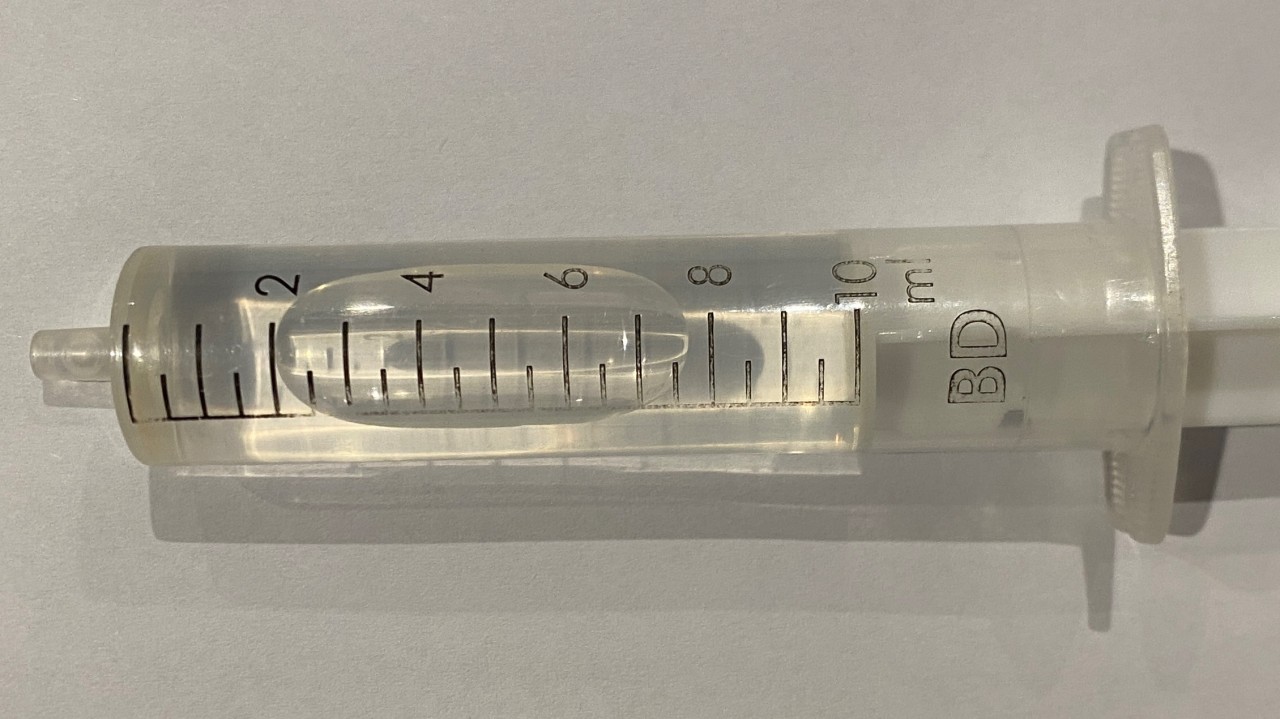
To begin my experiment on accuracy of testing, I took a sample from a closed system and determined the molybdate level using a 10ml sample and 10x drops of molybdate liquid reagent, as specified by the photometer manufacturer’s instructions. A 10ml syringe was used for measurement. The same vial was used for the blank and all tests. The blank was “saved” on the photometer and used for all tests. All good practice was followed: The cuvette was rinsed with DI water, dried inside between each test.
I completed this step 5 times with the following results:
Test 1: 177.9 mg/l Test 2: 180.4 mg/l Test 3: 183.3 mg/l Test 4: 175.5 mg/l Test 5: 180.4 mg/l
Range = 7.8 mg/l (~4.3%), which is acceptable variance for field use. I used the mean average result (179.5 mg/l) as a control on which to judge the other results.
Results
Initially, I sucked some air in to the syringe to create bubbles. I did this 3 times with progressively bigger bubbles, with the following results:
Small bubble: 183.3 mg/l Medium bubble: 183.3 mg/l Large bubble: 175.5 mg/l
All these results are in the range of the control tests, so I experimented with different sample volumes, as per below:
5 ml: 168.8 mg/l 6 ml: 173.1 mg/l 7 ml: 183.3 mg/l 8 ml: 180.4 mg/l 9 ml: 180.4 mg/l 10 ml: Control 11 ml: 180.4 mg/l 12 ml: 177.9 mg/l
It is clear from the data that the results stayed within the correct range from 7 ml – 12 ml.
Understanding the results
The outcome is very simple to understand, even if not immediately intuitive. Regardless of the sample volume, the concentration of molybdate in the sample remains the same (around 180 mg/l).
It is easy to assume – I did – that the reagent reacts with the mass of molybdate in the sample, so a larger volume (and higher mass) of molybdate would produce a more intense colour. This is not the case.
The Beer-Lambert law shows that absorbance (what a photometer reads) is proportional to concentration: A = ε ⋅ c ⋅ l
What happens is the reagent reacts with the molybdate to form a coloured species. The photometer measures the intensity of this colour and converts it to mg/l using a calibration curve. Even if there is more mass of molybdate in the 12 ml sample, and as such, more coloured species – the density of these species is the same – and so the colour intensity that the photometer reads is also the same.
Picture making a glass of squash. If you use a tiny glass, you’ll need a tiny amount of concentrated squash to achieve the strength / colour you like. Now imagine making a 2L bottle of squash, you’ll have to use much more concentrated squash to achieve the same strength / colour. If we could put our glass of squash into a photometer, it would read the strength, and it would be the same for the tiny glass and the 2L bottle.
The exception is for the 5 ml and 6 ml samples. The cuvettes were simply not filled enough to cover the light path of the photometer, so the photometer was partially reading empty glass cuvette. The level at which this becomes an issue will depend on the manufacturer of the photometer.
Experiment 2 – Reagent Volume Accuracy
So then, if we can be reasonably inaccurate with our sample measurement, how about reagent? Some people have a preference of tablet reagents over powder or liquid reagents for use in photometers as they provide an exact reagent amount every time – meaning consistency. I shared this opinion, but wanted to find out with another experiment:
Question
What is the effect of inaccurate reagent measurements whilst using a photometer for closed system testing?
Hypothesis
Inaccurate reagent measurement would lead to inconsistent results.
Methodology
For this experiment, I took one 10 ml sample of the same sample water as experiment 1. I added one drop at a time of molybdate reagent, testing it on the photometer at each drop.
Results
1 Drop: 162.4 mg/l 2 Drops: 183.3 mg/l Every test 3–10 drops: 183.3 mg/l
The result was the same at 2 drops of reagent as at 10 drops. The maximum range of this photometer test is 200 mg/l, so even at only 2 drops, the test range is nearly maxed out.
Understanding the results
Engineer test kits are built to be robust and for field-use, not laboratory precision. For these, amongst other more cynical reasons, reagents are designed to be used in excess. This means that the limiting factor will always be the test parameter, not the reagent.
In the example of this experiment, when only one drop of reagent was used, there was excess molybdate that had not undergone a colour-forming reaction. The reagent was the limiting factor. At two drops, all molybdate in the sample had reacted with the reagent. Molybdate became the limiting factor. The remaining eight drops of reagent have no molybdate to react with and so do not form coloured complexes. Essentially, they are wasted.
Key Takeaway
When using a photometer, accurate and consistent results can still be achieved even when sample volume and reagent volume are not perfectly measured, provided the optical path is covered and the reagent remains in excess.
Note: These findings apply to this test-type, and although it can be reasonably assumed that many of the findings will transfer to other tests, not all photometer tests behave identically.