
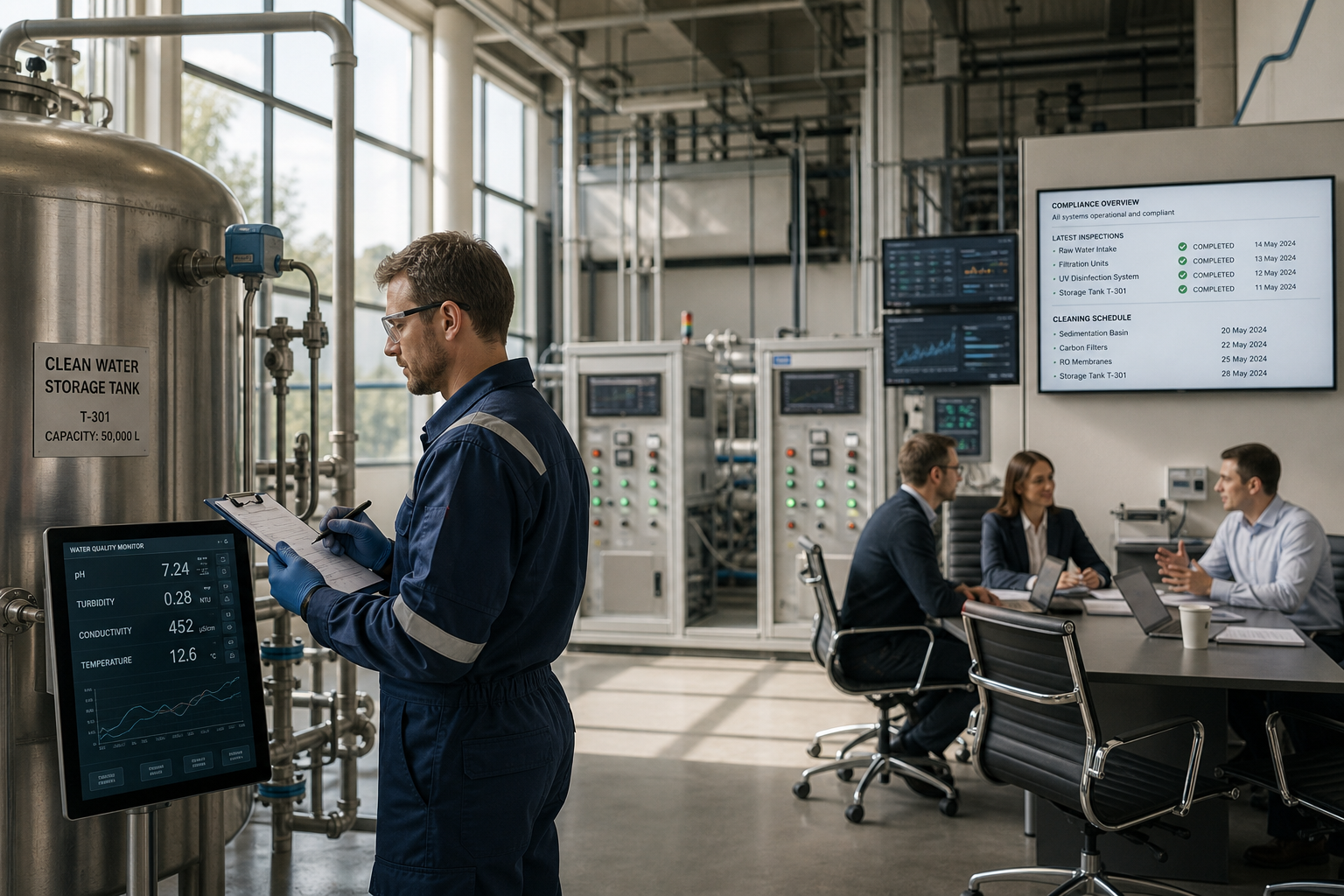
Managing water safety across a UK facility means juggling multiple responsibilities at once: regular inspections, monitoring schedules, cleaning routines, disinfection protocols, and a mountain of compliance documentation. For facilities managers in healthcare, education, and commercial buildings, these tasks are not optional extras—they are legal obligations under the Health and Safety at Work Act 1974 and the Approved Code of Practice L8.
This guide breaks down everything you need to know about water treatment services that integrate monitoring, inspection, cleaning, and disinfection into one cohesive service model. Whether you are responsible for a single building or a multi-site estate, you will find practical guidance on meeting your legal duties while protecting building occupants from waterborne hazards like Legionella bacteria.
SMS Environmental brings together expert knowledge with smart technology to deliver water treatment services that keep UK facilities compliant and safe. By the end of this guide, you will understand what an integrated water treatment service looks like, how to evaluate providers, and what questions to ask before signing a contract.
Key Takeaways: Water Treatment Services for UK Facilities in 2026
- Water treatment services for UK facilities must include monitoring, inspection, cleaning, and disinfection to meet ACoP L8 requirements fully.
- Integrated service models reduce compliance gaps by combining all water hygiene activities under one accountable provider.
- SMS Environmental offers UKAS-accredited risk assessments and real-time monitoring through its Opuz compliance software for complete visibility.
- UK facilities managers should prioritise providers with proven accreditations, transparent reporting, and a single point of contact.
- Software-led visibility into service records and audit trails is now essential for demonstrating due diligence to regulators and inspectors.
What Are Water Treatment Services for UK Facilities?
Water treatment services cover the full range of activities required to maintain safe, compliant water systems in buildings. For UK facilities, this typically includes managing hot and cold water systems, cooling towers, steam boilers, closed-circuit heating, and specialised systems like spa pools.
The primary goal is to control the growth of harmful microorganisms—particularly Legionella bacteria—while also preventing corrosion, scale, and fouling that can damage equipment and reduce efficiency. These services go beyond simple maintenance; they form the backbone of your building's water safety management plan.
The Four Pillars of Water Treatment Services
An effective water treatment programme rests on four interconnected pillars: monitoring, inspection, cleaning, and disinfection. Each serves a distinct purpose, but they work best when delivered as part of an integrated service.
Monitoring tracks water temperatures, chemical dosing levels, and bacterial counts on an ongoing basis. Inspection identifies physical issues like dead legs, damaged fittings, or areas where water can stagnate. Cleaning removes biofilm, sediment, and debris that harbour bacteria. Disinfection eliminates any remaining microorganisms to restore safe conditions.
Why Monitoring Forms the Foundation of Water Hygiene
Monitoring is your early warning system. Regular temperature checks, chemical analysis, and bacterial sampling give you the data needed to spot problems before they become outbreaks.
Under ACoP L8 and HSG274, you must demonstrate that your water systems are operating within safe parameters. This means recording temperatures at sentinel outlets, tracking chlorine or biocide residuals, and testing for Legionella at appropriate intervals.
Manual Versus Automated Monitoring
Traditional monitoring relies on technicians visiting your site to take readings and samples. While this approach can work for smaller buildings, it has limitations for multi-site estates where conditions can change rapidly between visits.
Automated monitoring systems use sensors to capture data continuously and transmit it to a central platform. SMS Environmental's SMS Sense IoT monitoring system delivers minute-by-minute sensor data, alerting you immediately if temperatures drift outside safe ranges. This real-time visibility means you can respond to issues before they escalate into compliance breaches or health risks.
What to Monitor in Your Water Systems
Your monitoring programme should cover all areas where Legionella and other pathogens could thrive. Focus on hot water storage vessels, calorifiers, cold water tanks, thermostatic mixing valves, showerheads, and any outlet that creates aerosols.
Temperature monitoring is particularly important. Hot water should be stored at 60°C or above and distributed at 50°C or above. Cold water should remain below 20°C. Deviations from these ranges create conditions where bacteria can multiply rapidly.
How Water System Inspections Protect Your Facility
Inspections identify the physical and operational factors that could allow bacteria to grow in your water systems. A thorough inspection goes beyond visual checks to assess system design, maintenance history, and compliance with current standards.
The HSE guidance on preventing and controlling risk makes clear that you should keep pipe lengths as short as possible, remove redundant pipework, and avoid materials that encourage bacterial growth. Inspections reveal whether your systems meet these requirements.
Risk Assessment Inspections
A legionella risk assessment is the starting point for any water treatment programme. It identifies potential sources of risk, assesses who might be exposed, and determines what control measures you need to implement.
Under UK law, this assessment is not optional. SMS Environmental delivers UKAS ISO 17020 accredited legionella risk assessments, ensuring your inspection is carried out by competent assessors who understand both the technical and regulatory requirements. This accreditation demonstrates competency and impartiality—key factors if your assessment is ever scrutinised by the HSE or in legal proceedings.
Routine Inspection Schedules
Beyond the initial risk assessment, you need a programme of routine inspections to verify that control measures remain effective. This includes monthly checks on water temperatures, quarterly inspections of showerheads and other outlets, and annual reviews of the full system.
Each inspection should be documented and stored in a format that allows easy retrieval during audits. The Opuz Portal from SMS Environmental gives you full transparency of worksheets and documentation, with multiple user logins so your whole team can access records when needed.
The Role of Cleaning in Water Treatment Services
Cleaning removes the organic matter, scale, and sediment that create ideal conditions for bacterial growth. Even well-managed systems accumulate deposits over time, so regular cleaning is essential to maintain hygiene standards.
The frequency and method of cleaning depend on your system type and risk assessment findings. Open systems like cooling towers require more frequent attention than closed circuits, and systems in healthcare settings often need stricter regimes than standard commercial buildings.
Tank and Cistern Cleaning
Cold water storage tanks and cisterns are common problem areas. Sediment settles at the bottom, providing nutrients for bacteria, while damaged lids or overflow pipes can allow contamination from outside sources.
Professional cleaning involves draining the tank, removing all sediment and biofilm, disinfecting the internal surfaces, and refilling with clean water. The tank should then be tested to confirm that water quality meets acceptable standards before returning to service.
Pipework and Distribution System Cleaning
Biofilm—a slimy layer of bacteria embedded in organic material—can coat the inside of pipes and protect pathogens from chemical treatment. Mechanical cleaning or high-velocity flushing may be needed to remove established biofilm.
Dead legs—sections of pipework where water sits unused—are particularly prone to contamination. Your cleaning programme should include identifying and either removing or regularly flushing these areas to prevent bacterial accumulation.
Cooling Tower Cleaning
Cooling towers present a higher risk because they can generate aerosols that travel significant distances. Regular cleaning of the tower pack, drift eliminators, and sump is essential to control both Legionella and general microbial contamination.
The HSE requires that cooling towers be cleaned and disinfected at least twice a year, with additional cleans after any shutdown period or if monitoring indicates elevated bacterial counts. Documentation of all cleaning activities forms part of your written control scheme.
Understanding Disinfection Methods for Water Systems
Disinfection kills microorganisms that remain after cleaning or that have built up between service visits. The choice of disinfection method depends on your system type, the level of contamination, and whether you are conducting routine treatment or responding to a specific issue.
Chlorination and Chlorine Dioxide
Chlorination remains the most common method for disinfecting potable water systems. Chlorine is added at a concentration sufficient to achieve a residual throughout the system, ensuring all pipework and outlets are treated.
SMS Environmental has the expertise to carry out the full spectrum of chlorination works, including mains water, down services, and storage tanks. All work follows BS 8558:2015 standards and HSE guidance, with certification provided on completion.
Chlorine dioxide offers an alternative for systems where standard chlorination may not be suitable. It is effective at lower concentrations and better at penetrating biofilm, making it useful for heavily contaminated systems or those with complex pipework.
Thermal Disinfection
Thermal disinfection involves raising water temperature to a level that kills bacteria. For hot water systems, this typically means circulating water at 70°C through all outlets for a sustained period.
This method can be effective but carries risks. High-temperature water can cause scalds if outlets are used during the process, and sudden temperature changes can damage some fittings. Professional planning and clear communication with building occupants are essential.
When to Disinfect Your Water System
Routine disinfection may be part of your ongoing maintenance schedule, particularly for higher-risk systems. You should also consider disinfection after:
- New installations or significant alterations to the system
- Extended shutdowns where water has been standing
- Positive Legionella test results
- Outbreaks of waterborne illness linked to your building
- Any situation where monitoring indicates loss of control
How Integrated Water Treatment Services Improve Compliance
Many facilities managers work with multiple contractors for different aspects of water management—one for risk assessments, another for monitoring, a third for remedial works. This fragmented approach creates gaps where issues can fall through the cracks.
An integrated service model brings all water treatment activities under one provider. This means a single point of accountability, consistent documentation, and better coordination between monitoring findings and corrective actions.
Reducing the Risk of Compliance Gaps
When monitoring, inspection, cleaning, and disinfection are managed separately, communication breakdowns are common. A monitoring report might flag elevated temperatures, but the information takes weeks to reach the team responsible for remedial works.
Integrated providers close these gaps by linking monitoring data directly to service workflows. If SMS Environmental's SMS Sense system detects an anomaly, the same team that monitors the data can schedule the inspection or corrective action, reducing response times and ensuring nothing is missed.
Simplified Record-Keeping and Audit Trails
Regulators and inspectors want to see clear evidence that you have identified risks, implemented controls, and verified their effectiveness. Scattered records across multiple providers make this difficult to demonstrate.
A unified compliance platform like Opuz consolidates all records—risk assessments, monitoring data, service reports, and corrective actions—in one accessible location. This makes audits straightforward and gives you confidence that your due diligence is properly documented.
What UK Facilities Managers Should Look for in a Water Treatment Provider
Choosing a water treatment provider is a significant decision. The wrong choice can leave you exposed to compliance failures, unexpected costs, and—in the worst case—harm to building occupants. Here are the key factors to evaluate.
Accreditations and Certifications
Look for providers with recognised accreditations that demonstrate competency and commitment to quality. UKAS accreditation for risk assessments is particularly important, as it shows the provider has been independently verified to meet rigorous standards.
Other valuable certifications include ISO 9001 for quality management, ISO 14001 for environmental management, and membership of the Legionella Control Association (LCA). These indicate a provider that takes compliance seriously and subjects itself to regular external scrutiny.
Technical Expertise and Training
Water treatment is a technical discipline that requires specialist knowledge. Ask about the qualifications of the team who will be working on your site. Are technicians trained to recognised standards? Is the provider a City and Guilds assured training provider?
SMS Environmental's technical teams undergo rigorous training, and the company holds City and Guilds assured status for its Water Treatment Technologist programme. This investment in expertise translates to better service quality and more reliable compliance outcomes.
Technology and Reporting Capabilities
Modern water treatment services should include robust technology for data capture, analysis, and reporting. Paper-based systems are no longer adequate for the volume of data that effective monitoring generates.
Ask potential providers about their digital platforms. Can you access records online? Do you receive automated alerts when parameters drift outside safe ranges? Is there a clear audit trail for all service activities? These capabilities are not luxuries—they are essential for demonstrating compliance in 2026.
Responsiveness and Communication
Issues with water systems can escalate quickly. A provider that takes days to respond to urgent calls is not suitable for facilities where occupant safety depends on rapid action.
Discuss response times during your evaluation. How quickly can the provider mobilise if you have a positive Legionella test? What is the escalation process for emergencies? Clear answers to these questions indicate a provider you can rely on when it matters most.
Legal Requirements for Water Treatment in UK Buildings
Understanding your legal obligations is fundamental to managing water safety. UK law places clear duties on employers and those in control of premises to assess and control the risk of Legionella and other waterborne hazards.
The Health and Safety at Work Act 1974
This primary legislation requires employers to ensure, so far as is reasonably practicable, the health, safety, and welfare of employees and others who may be affected by their undertaking. Water systems fall within scope because poorly managed systems can cause serious illness.
COSHH Regulations 2002
The Control of Substances Hazardous to Health Regulations classify Legionella bacteria as a biological agent. This means you must assess the risks, implement control measures, and ensure those measures remain effective over time.
ACoP L8 and HSG274
The Approved Code of Practice L8 has special legal status. While not law itself, courts will find you at fault if you have not followed the ACoP's guidance unless you can show you have met your duties in an equally effective way.
HSG274 details technical guidance on implementing the ACoP for different system types. Part 2 covers hot and cold water systems—the most common type in UK facilities—and should be on every facilities manager's reading list.
Consequences of Non-Compliance
Failing to meet your water safety duties can result in enforcement action by the HSE, including improvement notices, prohibition notices, and prosecution. In serious cases, individuals can face personal liability and even imprisonment.
Beyond regulatory penalties, a Legionnaires' disease outbreak linked to your building can result in civil claims for damages, reputational harm, and loss of business. Prevention is always more cost-effective than dealing with the consequences of poor management.
Building a Written Control Scheme for Your Water Systems
ACoP L8 requires you to have a written scheme for controlling risks from water systems. This document describes your systems, the risks they present, and the measures you have put in place to manage those risks.
What Your Control Scheme Should Include
Your written control scheme should contain:
- A description of your water systems, including schematic diagrams
- Names and responsibilities of the responsible person and other key personnel
- Risk assessment findings and the control measures they require
- Operational procedures for safe system management
- Monitoring schedules and the parameters to be checked
- Cleaning and disinfection procedures and frequencies
- Record-keeping requirements and document retention periods
- Emergency procedures for responding to incidents or positive test results
Keeping Your Control Scheme Current
A control scheme is not a one-time document. You must review it regularly—at least annually—and update it whenever there are significant changes to your systems, building use, or the occupant population.
Regular reviews also help you identify whether control measures are working. If monitoring consistently shows problems in certain areas, your scheme should be updated to address those issues with additional or alternative controls.
Multi-Site Compliance: Managing Water Treatment Across Estates
If you are responsible for multiple buildings, the complexity of water treatment multiplies. Each site may have different system types, risk profiles, and maintenance histories, making consistent management a challenge.
Centralised Oversight With Local Delivery
The most effective approach combines centralised oversight with local service delivery. A single platform gives you visibility across all sites, while technicians on the ground understand the specific conditions at each location.
SMS Environmental supports facilities managers across multi-site estates with this model. The Opuz compliance software allows you to view status and records for all your buildings in one place, while regional teams deliver services with knowledge of local requirements and relationships.
Standardising Procedures and Documentation
Consistency is key for multi-site compliance. Develop standard procedures that apply across your estate, adapted as needed for site-specific factors. Use standardised templates for risk assessments, service reports, and monitoring records so information is comparable and auditable.
When working with a water treatment provider, agree on reporting formats and data sharing protocols from the outset. This avoids the confusion that can arise when different sites produce different types of documentation.
The Value of Software-Led Visibility in Water Treatment
Paper logbooks and spreadsheets can no longer keep pace with the demands of modern water compliance. Digital platforms offer capabilities that transform how you manage water safety.
Real-Time Dashboards and Alerts
Instead of waiting for monthly reports, real-time dashboards show you the current status of all monitored parameters. Alerts notify you immediately when something needs attention, allowing faster response and reducing the window for problems to develop.
Automated Compliance Tracking
Software can track when tasks are due, flag overdue items, and maintain a complete history of all activities. This automation reduces the administrative burden on your team and ensures nothing falls through the gaps in busy periods.
Audit-Ready Records
When an inspector asks to see your water safety records, you want to produce them quickly and confidently. Digital platforms make this straightforward, with search functions, export capabilities, and organised document storage that paper systems cannot match.
The Opuz Portal from SMS Environmental delivers these capabilities, giving you clearer, more accurate compliance visibility and supporting confident internal reporting to senior leadership and boards.
How to Evaluate Whether Your Current Water Treatment Approach Is Working
If you already have water treatment services in place, periodic evaluation helps you identify gaps and improvement opportunities. Here are questions to consider.
Questions About Service Quality
Are services being delivered on schedule? Review completion rates for scheduled visits and compare them against your contract terms. Consistent missed or rescheduled visits may indicate resource or capability issues with your provider.
Are findings being acted upon? Check whether recommendations from risk assessments and inspections are being implemented. A backlog of unaddressed remedial works represents ongoing risk exposure.
Questions About Compliance Documentation
Can you produce complete records for the past two years? Regulators typically request records for this period. Gaps or inconsistencies in your documentation could be problematic if you face an investigation.
Are records easy to understand and navigate? Documentation that only makes sense to the technician who created it has limited value for demonstrating compliance to external parties.
Questions About Communication and Responsiveness
Do you receive clear, timely reports after each service visit? Information that arrives weeks late loses much of its value for managing ongoing risks.
Can you reach your provider quickly when issues arise? Test this by noting response times to queries and urgent requests. A provider that is difficult to contact during normal times may be even harder to reach during an emergency.
Planning for Water System Shutdowns and Seasonal Changes
Building closures, seasonal variations in occupancy, and system shutdowns all affect water safety. Planning ahead helps you manage these situations without creating compliance problems.
Shutdown and Recommissioning Procedures
When a building or system will be out of use for an extended period, you need procedures to minimise risk during the shutdown and ensure safe recommissioning before reoccupation.
For shorter shutdowns (less than a week), regular flushing may be sufficient. Longer periods typically require draining systems, disinfection before recommissioning, and testing to confirm water quality before occupants return.
Summer Considerations
Warm weather increases the risk of Legionella growth, particularly in cold water systems that can exceed 20°C during heat waves. Review your monitoring data from previous summers to identify problem areas and consider additional controls during high-risk periods.
Summer is also an ideal time for planned remedial works, as school and university buildings have reduced occupancy and maintenance windows are easier to schedule.
Training Your Team on Water Safety Responsibilities
Effective water safety management requires competent people at every level. Training ensures that those with responsibilities understand their duties and can carry them out correctly.
Training for Responsible Persons
The person with day-to-day responsibility for water safety needs training that covers the regulatory framework, risk assessment principles, control measures, and monitoring requirements. This training should be refreshed periodically as regulations and best practices evolve.
SMS Environmental offers City and Guilds assured legionella training courses designed specifically for responsible persons. These practical courses cover what you need to know to manage water safety confidently and comply with your legal duties.
Awareness Training for Wider Staff
Building users and maintenance staff also benefit from awareness training. They should understand the basics of Legionella risk, recognise signs that something may be wrong, and know who to report concerns to.
Tailored training ensures that information is relevant to each audience. A maintenance technician needs different knowledge than an office administrator, even though both work in the same building.
In Conclusion: How to Choose the Right Water Treatment Services for Your UK Facility
Water treatment services are not a cost to be minimised—they are an investment in the safety of everyone who uses your buildings. Choosing the right approach and provider can mean the difference between confident compliance and constant anxiety about regulatory scrutiny.
Start by understanding your legal duties under ACoP L8 and related regulations. These are not suggestions; they are requirements with serious consequences for non-compliance.
Look for providers who offer integrated services covering monitoring, inspection, cleaning, and disinfection. A single accountable partner reduces gaps and simplifies management.
Prioritise providers with strong accreditations, particularly UKAS accreditation for risk assessments. This independent verification gives you confidence that work is being done to recognised standards.
Demand technology that gives you visibility into your compliance status. Real-time monitoring, automated alerts, and accessible digital records are now baseline expectations, not premium extras.
Finally, remember that water safety is an ongoing responsibility, not a box to tick once and forget. Regular reviews, continuous improvement, and genuine engagement with your provider will keep your facilities safe and compliant for years to come.
FAQs about Water Treatment Services for UK Facilities in 2026
What services should be included in a water treatment contract for UK facilities?
A water treatment contract should include legionella risk assessments, temperature monitoring, water sampling and analysis, tank and system cleaning, disinfection services, and ongoing compliance documentation. SMS Environmental delivers all these services through an integrated model, ensuring nothing falls between the gaps.
How often do UK facilities need legionella risk assessments?
You must review your legionella risk assessment regularly—at least every two years—and whenever there are significant changes to your water systems or building use. More frequent reviews may be needed for higher-risk premises like healthcare facilities.
What is the difference between cleaning and disinfection in water treatment?
Cleaning removes physical debris, sediment, and biofilm from your water system. Disinfection uses chemicals or heat to kill microorganisms that remain after cleaning. Both are necessary for effective Legionella control, and SMS Environmental's technicians are trained to deliver both services to recognised standards.
Why is UKAS accreditation important for legionella risk assessments?
UKAS accreditation demonstrates that a risk assessment provider has been independently verified for competency and impartiality. This gives you confidence in the assessment quality and helps demonstrate due diligence if your compliance is ever questioned by regulators or in legal proceedings.
How can facilities managers reduce the administrative burden of water compliance?
Digital compliance platforms significantly reduce administrative work by automating task tracking, centralising records, and generating reports automatically. SMS Environmental's Opuz Portal gives you full transparency of service activities and documentation, making compliance management more efficient across single or multi-site estates.
What should I do if a water sample tests positive for Legionella?
A positive Legionella test requires immediate action. Review your risk assessment, implement additional control measures, consider disinfection, and resample to verify the issue is resolved. Your water treatment provider should support you through this process with expert guidance and rapid service delivery.
Can remote monitoring replace manual water system inspections?
Remote monitoring complements but does not replace physical inspections. Sensors can track temperatures and alert you to anomalies continuously, but inspections are still needed to assess physical condition, identify design issues, and verify that control measures are working as intended. The combination of both approaches offers the most reliable risk management.