
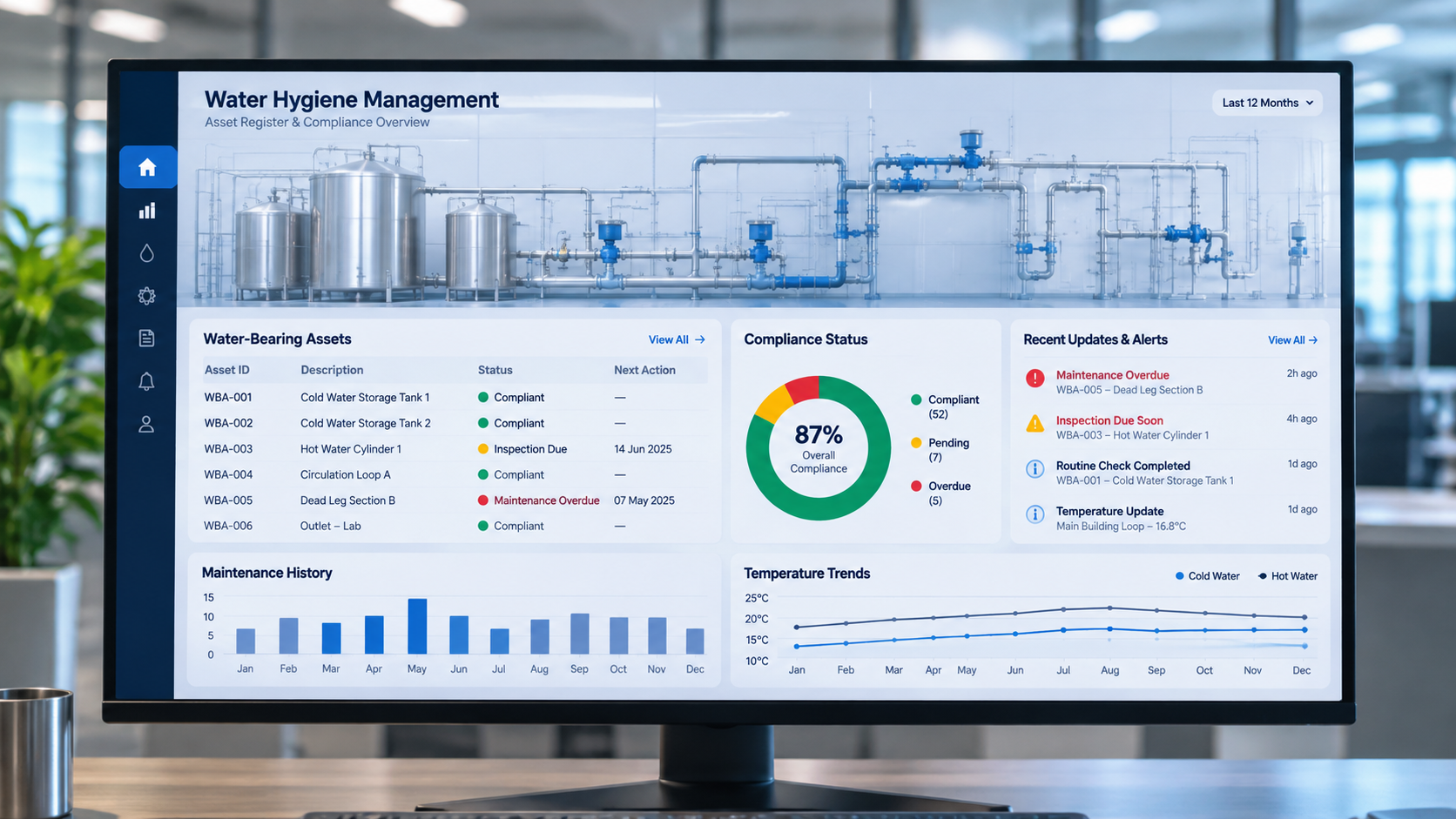
If you manage water systems across several buildings, keeping an accurate record of every water asset is one of the harder parts of your compliance programme. Missed outlets, out-of-date schematics and records spread across spreadsheets all make it harder to show that Legionella risk is under control.
This guide covers what a water hygiene asset register should contain, how to build one, and how to keep it accurate over time. It applies whether your estate covers hospitals, universities, housing or commercial property.
In brief
- An asset register is an inventory of every water-bearing asset across your estate, from storage tanks and calorifiers to individual outlets.
- The law doesn't require an "asset register" by name. It is the most practical way to hold the records that ACoP L8 and HSE guidance expect you to keep.
- Across multiple sites, a central digital system is easier to keep current than separate spreadsheets.
- Registers drift out of date. Planned reconciliation against what is actually on site keeps them reliable.
What a water hygiene asset register is
A water hygiene asset register is a structured inventory of every water-bearing component in a building or estate. For each asset it records what it is, where it sits in the system, its specification, its maintenance history and its current status.
It typically covers cold water storage tanks, calorifiers, thermostatic mixing valves (TMVs), showers and outlets, including those designated as sentinel outlets for temperature monitoring. Where an estate has cooling towers or evaporative condensers, these should be included as a priority.
The register is a working record rather than a one-off document. It needs updating whenever assets are added, removed, replaced or decommissioned. Otherwise there is a gap between what your compliance programme manages and what is actually on site.
Why it matters for Legionella compliance
Your legal duties come from the Health and Safety at Work etc. Act 1974 and the Control of Substances Hazardous to Health (COSHH) Regulations 2002. The Management of Health and Safety at Work Regulations 1999 require you to assess risk.
The HSE's Approved Code of Practice, ACoP L8, sets out how to comply with these duties for Legionella. HSE guidance HSG274 Parts 1 to 3 gives the technical detail.
Under ACoP L8, the dutyholder (the employer or person in control of the premises) must make sure a suitable and sufficient risk assessment is carried out. They appoint a responsible person to manage control measures day to day.
The assessment must be reviewed regularly, and whenever there is reason to think it is no longer valid. Examples include changes to the water system or how it is used.
ACoP L8 also expects records to be kept, including the significant findings of the risk assessment, the written control scheme and the results of monitoring, inspection and checks. The written scheme should include an up-to-date schematic of the water system. A risk assessment can only cover the assets it knows about, which is why an accurate register matters.
In healthcare, HTM 04-01 recommends a Water Safety Group and a water safety plan, supported by structured record-keeping. For healthcare estates, an accurate asset register underpins both.
What your register should include
A complete register holds two kinds of information: fixed details about each asset, and records that change over time.
Identification and location. Give every asset a unique reference, a description and a location tied to a specific site, building, floor, room or riser. On a multi-site estate, records must never be confused between sites.
Technical details. Record storage capacities, temperature set points, materials and manufacturer details. These inform inspection frequencies, treatment regimes and replacement planning.
Service and maintenance history. Keep a dated log of inspections, servicing, sampling results, remedial works and modifications for each asset. Over time this shows recurring issues before they become bigger problems.
Link to the risk assessment. Cross-reference each asset to the relevant risk assessment findings and control measures. That way every recommendation can be traced to an asset and confirmed as complete.
Current status. Show whether each asset is compliant, due for inspection, awaiting remedial work or decommissioned. Your team can then see at a glance where attention is needed.
Building your register step by step
The method below works for an estate of any size. The work simply grows with the number of sites and assets.
- Survey every site. Walk each building and record every water-bearing asset, its location, type and condition. Look out for the items most often missed: little-used outlets, dead legs and redundant pipework.
- Compare against existing records. Check what you found against the current register, schematics and risk assessment. Differences are common, particularly in older buildings or after refurbishment.
- Assign unique references. Agree one naming convention for the whole estate, for example site code, building, floor and asset type. Use it in every record, work order and report.
- Add technical and historical data. Enter specifications, installation dates and any maintenance history you hold. Where history is missing, prioritise those assets for inspection so you can set a baseline.
- Connect it to your compliance system. If you use a digital platform, hold the register there so that maintenance tasks, monitoring and sampling results attach to the right asset.
- Check it against the risk assessment. Every asset in the risk assessment should appear in the register, and every asset in the register should be covered by the risk assessment. Resolve any mismatch before the register is signed off.
Why spreadsheets struggle across multiple sites
For a single building, a well-kept spreadsheet can work. Across several sites, it quickly becomes difficult to manage.
When each site has its own file, accuracy depends on whoever last updated it. Version control is hard, handovers between teams introduce errors, and producing an estate-wide picture means collating files by hand.
The bigger problem is disconnection. When sampling results are held in one place, service records in another and the risk assessment in a third, nobody has a complete view of a given asset. A central system lets each result, certificate and action sit against the asset it relates to. If an auditor asks for the history of a specific calorifier, you can produce it quickly.
Remote temperature monitoring adds to this. Sensors on key assets record readings between site visits and raise an alert when a reading falls outside set limits. Over months, that data can reveal patterns, such as repeated low temperatures on one circuit, that point to an underlying problem.
Keeping your register accurate
Most registers are accurate on the day they are completed. The challenge is keeping them that way. These are the problems we see most often, and how to avoid them.
Gradual drift. Assets are added, removed or moved without the register being updated. A planned reconciliation, which we recommend at least once a year, means walking each site and checking the register in both directions: everything listed exists, and everything that exists is listed.
Changes after building work. Refurbishments, extensions and changes of use often alter pipework and outlets. Treat any of these as a trigger to review the register and the risk assessment before the next monitoring cycle.
Inconsistent naming. When contractors or teams use different references for the same asset, reports become unreliable. Agree a single convention at the start and make sure everyone who updates the register follows it.
Deleted rather than decommissioned. Don't delete assets that have been removed or isolated. Record the date, the reason and any associated works. This keeps a complete audit trail and shows that changes to the system were managed deliberately.
Out of step with the risk assessment. Each time the risk assessment is carried out or reviewed, check that the register still matches it and the building.
How we can help
Our Legionella risk assessments are carried out by our UKAS accredited assessment team using our compliance system, Opuz.
Opuz brings your assets and compliance records together in one place, with multi-site and multi-building accounts. Planned maintenance tasks can be scheduled from the risk assessment's recommendations. Your own team or our engineers complete them through the Opuz mobile app. Defects are raised as hazards on your risk management plan, and overdue tasks are flagged for review. You keep a full audit trail and can export your data at any time.
Opuz IoT sensors connect directly to the platform for remote temperature and anti-stagnation flushing monitoring. Alerts are sent when readings go outside the limits you set, and the actions taken are recorded alongside your on-site inspections.
If your register is out of date, or held across too many spreadsheets to manage, we can help you get it back under control. Talk to our team about your asset register.
Frequently asked questions
What is a water hygiene asset register used for?
It lists every water-bearing asset in a building or estate, with its location, specification, maintenance history and status. It supports your Legionella risk assessment and the records ACoP L8 expects you to keep.
Is an asset register a legal requirement?
The law doesn't name an "asset register". However, you must assess and control the risk from Legionella. ACoP L8 expects records such as the risk assessment findings, the written control scheme, a schematic of the system and monitoring results. A register is the most practical way to keep these accurate and connected.
Who is responsible for the register?
The legal duty sits with the dutyholder, meaning the employer or person in control of the premises. Day-to-day management is usually given to an appointed responsible person. They may be supported by an estates team or a water hygiene provider.
How often should the register be updated?
Update it whenever assets are added, removed or changed. We recommend a full reconciliation against each site at least once a year, and after any refurbishment or change of use that affects the water system.
What happens if the register is inaccurate?
Assets missing from the register may also be missing from the risk assessment and control scheme. This leaves part of the system unmanaged and makes it harder to show an inspector or auditor that risk is under control.
Sources
- HSE: Legionnaires' disease, ACoP L8
- SMS Environmental: Opuz compliance software
- SMS Environmental: Opuz IoT remote monitoring
- SMS Environmental: Legionella risk assessment