
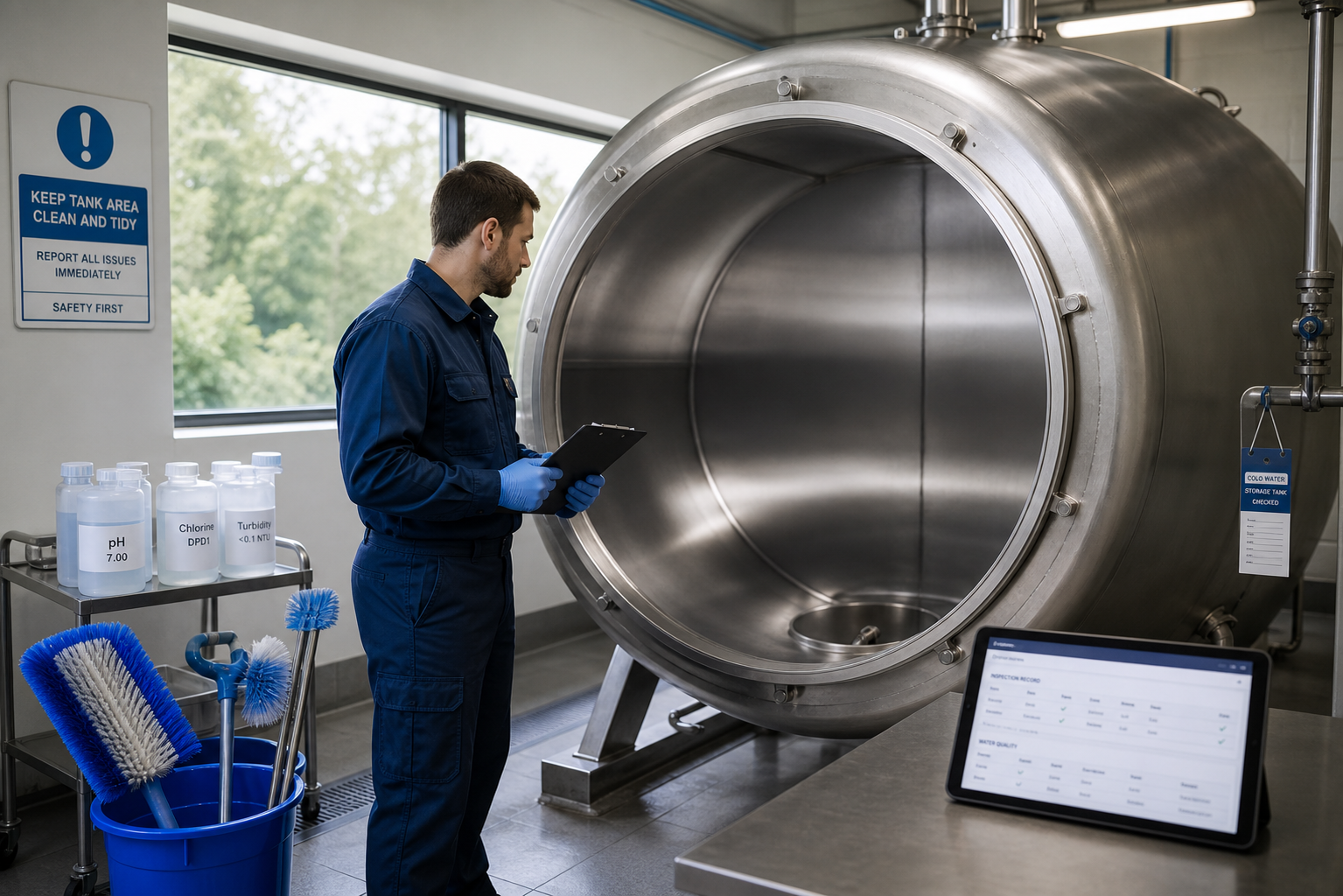
If you manage a UK building with cold water storage tanks, you already know that tank cleaning is not optional. ACoP L8 and HSG274 Part 2 place a legal duty on every responsible person to keep stored water free from harmful bacteria, sediment, and biofilm. Neglect that duty, and you risk Legionnaires' disease outbreaks, HSE enforcement action, and costly remedial work.
This guide walks you through everything you need to know about water tank cleaning and disinfection for compliance-critical buildings. From inspection schedules and cleaning methods to record-keeping and ongoing monitoring, every section is designed to help you act with confidence.
SMS Environmental delivers expert water treatment services across the UK, helping facilities managers protect building occupants and stay ahead of their compliance obligations.
Key Takeaways: The Complete Guide to Water Tank Cleaning in 2026
- Cold water storage tanks must be inspected at least annually and cleaned when sediment, damage, or contamination is found.
- ACoP L8 and HSG274 Part 2 set out the legal framework for water tank hygiene in UK buildings.
- Thermal and chemical disinfection are the two primary methods for eliminating bacteria after a tank clean.
- SMS Environmental pairs tank cleaning with UKAS-accredited risk assessments and digital audit trails through Opuz.
- Accurate records of every inspection, clean, and disinfection event are essential for demonstrating compliance during audits.
Why Water Tank Cleaning Matters for UK Buildings
Cold water storage tanks collect sediment, debris, and microbial growth over time. Even well-maintained systems can develop biofilm on internal surfaces, which creates a protected environment for bacteria, including Legionella pneumophila.
Left unchecked, contaminated tanks put building occupants at risk of Legionnaires' disease, a potentially fatal form of pneumonia. For healthcare premises, care homes, and educational buildings where vulnerable people live and work, the consequences of poor water hygiene can be severe.
Regular tank cleaning removes the conditions that allow bacteria to multiply. It also gives you the opportunity to inspect tank integrity, identify corrosion, and confirm that lids, screens, and overflows are intact and functioning correctly.
What Does UK Legislation Require for Water Tank Hygiene?
The legal framework for water hygiene in England and Wales rests on several key documents. The Health and Safety at Work Act 1974 places a general duty on employers and those in control of premises to ensure the safety of people who use the building.
ACoP L8, the Approved Code of Practice published by the HSE, sets out specific duties for managing the risk of exposure to Legionella bacteria. It requires you to appoint a responsible person, carry out a risk assessment, and implement a written control scheme.
HSG274 Part 2 is the supporting technical guidance for hot and cold water systems. It details how to inspect, monitor, clean, and disinfect water storage tanks. HSE guidance on hot and cold water systems confirms that cold water should be maintained below 20°C and hot water stored at 60°C or above to reduce the risk of Legionella growth.
How Often Should Cold Water Storage Tanks Be Cleaned?
HSG274 Part 2 states that cold water storage tanks should be inspected annually and cleaned as necessary. "As necessary" means whenever your inspection reveals sediment build-up, visible contamination, damage to the tank structure, or failed microbiological test results.
In practice, many compliance-critical buildings schedule a full clean and disinfection annually as a proactive measure. Healthcare premises often require more frequent attention, particularly where systems serve immunocompromised patients.
Your risk assessment should define the inspection and cleaning frequency for each tank on your estate. The assessment will take into account factors such as tank material, system age, usage patterns, and the vulnerability of building occupants.
What Happens During a Water Tank Inspection?
A thorough tank inspection covers much more than a visual check of the water surface. Your inspector should examine the external condition of the tank, including the base support and surrounding area, before moving to the internal assessment.
The internal inspection checks for sediment accumulation on the tank floor, biofilm on walls, corrosion or pitting of tank surfaces, and any signs of structural deterioration. The inspector should also confirm that lids are secure and in good condition, insect screens are fitted, overflow and warning pipes are intact, and there are no cross-connections with other water sources.
All findings should be recorded in detail with photographs where appropriate. This documentation forms a critical part of your compliance audit trail.
Common Issues Found During Tank Inspections
Poorly fitted or missing lids are among the most frequently identified issues. Without a secure, close-fitting lid, tanks are exposed to dust, insects, and airborne contamination that accelerate bacterial growth.
Corroded ball valves, degraded insulation, and redundant pipework connected to tanks are also common findings. Each of these issues should be flagged in your inspection report and addressed through remedial works before or alongside the cleaning process.
Step-by-Step Water Tank Cleaning Process
Professional tank cleaning follows a defined sequence to ensure thorough decontamination and minimal disruption to building services. Here is what to expect from a well-executed clean.
Step 1: Isolation and Drainage
The first step is to isolate the tank from the rest of the water system. This involves closing the inlet valve and draining the tank. Your service provider should coordinate with building management to plan for temporary water supply arrangements where needed.
Step 2: Manual Cleaning and Debris Removal
Once the tank is empty, technicians manually clean the interior surfaces. This involves scrubbing walls and the floor to remove sediment, biofilm, and scale deposits. All debris is collected and removed from the tank.
Step 3: Structural and Component Check
With the tank empty and clean, a detailed inspection of the internal structure takes place. This is the best opportunity to identify cracks, corrosion, or failing joints. Ball valves, float switches, and overflow mechanisms are checked and serviced or replaced if required.
Step 4: Disinfection
After cleaning, the tank is disinfected to eliminate any remaining bacteria. The two main approaches are thermal disinfection and chemical disinfection. The method chosen depends on the system type, tank material, and the specific circumstances identified in your risk assessment. We cover both methods in detail below.
Step 5: Refill, Flush, and Sampling
The tank is refilled and the entire downstream distribution system is flushed to remove disinfectant residues. Water samples are then taken and sent to a UKAS-accredited laboratory for microbiological analysis. The system is only returned to normal service once test results confirm the water meets acceptable standards.
What Are the Main Water Tank Disinfection Methods?
Two primary disinfection methods are used in UK water systems: thermal disinfection and chemical disinfection. Both are recognised by HSG274 Part 2 and BS 8558:2015 as effective approaches for eliminating harmful bacteria.
Thermal Disinfection
Thermal disinfection involves raising the water temperature throughout the system to at least 60°C and maintaining that temperature for a sustained period. The process requires flushing every outlet until the water runs at the target temperature for a minimum duration, typically at least five minutes.
This method is particularly relevant for hot water systems and can be effective in situations where chemical treatment is not practical. The main limitation is that thermal disinfection does not always reach every part of complex distribution networks, especially in larger buildings with long pipe runs.
Chemical Disinfection (Chlorination)
Chlorination is the most commonly used method for disinfecting cold water storage tanks and distribution systems. A measured dose of chlorine is added to the water at a predetermined concentration, typically 50 mg/l for a minimum contact time of one hour, or 20 mg/l for two hours, depending on the level of contamination.
After the required contact time, the system is thoroughly flushed until free chlorine residual drops to an acceptable level for drinking water. SMS Environmental's technical teams hold training to BS 8558:2015 and PD 855468:2015 standards, ensuring chlorination is carried out safely and in full compliance with current requirements.
How Does a Risk Assessment Connect to Tank Cleaning?
Your Legionella risk assessment is the foundation for every water hygiene decision you make, including when and how tanks should be cleaned. The assessment identifies all cold water storage tanks on your site, evaluates the risk each one presents, and defines the monitoring and maintenance actions needed to keep risk at an acceptable level.
A UKAS ISO 17020 accredited risk assessment gives you confidence that the evaluation has been carried out by competent, impartial assessors. SMS Environmental holds this accreditation and has over two decades of experience delivering risk assessments for healthcare, education, housing, and commercial estates across the UK.
When your risk assessment highlights issues with a particular tank, cleaning and disinfection should be scheduled promptly. The assessment should be reviewed and updated after any significant cleaning or disinfection event to reflect the current condition of the system.
Why Record-Keeping Is Critical for Water Tank Compliance
ACoP L8 requires that you keep records of all actions taken to comply with your written control scheme. For tank cleaning, that means documenting the date, scope, methods used, personnel involved, and the results of any post-disinfection sampling.
These records serve two purposes. First, they demonstrate to auditors and inspectors that you are meeting your legal duties. Second, they give you a clear history of each tank's condition over time, which helps you spot patterns and plan future maintenance more effectively.
Managing paper-based records across a large estate is difficult. Lost worksheets, incomplete logs, and delayed updates can leave gaps that are hard to explain during an audit. Digital compliance tools address these challenges by centralising records and making them accessible in real time. SMS Environmental's Opuz compliance software captures every inspection, clean, and disinfection event, giving you a complete audit trail that is always up to date.
How Does Ongoing Monitoring Support Tank Hygiene?
Cleaning and disinfection are not one-off events. Between scheduled cleans, regular monitoring helps you confirm that your water system remains safe and compliant. Monitoring activities for healthcare and other high-risk buildings typically include monthly temperature checks at sentinel outlets, quarterly microbiological sampling, and visual inspection of tank condition during routine site visits.
Temperature monitoring is especially important for cold water systems. HSE guidance states that cold water should be maintained below 20°C. Where ambient conditions or system design make it difficult to achieve this, additional control measures such as increased sampling or more frequent flushing may be needed.
IoT-based remote monitoring technology now makes it possible to track water temperatures across an entire estate in real time. SMS Environmental's SMS Sense system captures minute-by-minute sensor data, alerting you to temperature excursions before they become compliance failures.
What Should You Look for in a Water Tank Cleaning Provider?
Choosing the right provider for tank cleaning and disinfection is a decision that directly affects your compliance position. Here are the key factors to consider.
Accreditation and Competence
Your provider should employ technicians who are trained to current British Standards, including BS 8558:2015 for water supply hygiene and the requirements of HSG274 Part 2. Look for providers with UKAS accreditation for risk assessments and memberships of recognised industry bodies such as the Legionella Control Association.
Audit Trails and Documentation
A good provider delivers more than a clean tank. They should produce detailed documentation including photographic evidence, worksheets, and sampling results that integrate with your compliance records. Ask how the provider captures and stores this data, and whether you can access it digitally.
Integration with Your Wider Water Safety Plan
Tank cleaning should not happen in isolation from the rest of your water management programme. The most effective providers link cleaning activities to your risk assessment findings, monitoring data, and corrective action workflows. This joined-up approach reduces the risk of tasks falling through the cracks, particularly on multi-site estates.
How to Manage Water Tank Cleaning Across Multiple Sites
If you oversee water systems across several buildings, coordinating tank cleaning schedules, tracking compliance records, and managing different service providers can become a significant administrative challenge.
A single-provider model simplifies this process. Working with one water treatment partner across your entire estate means consistent standards, unified reporting, and a single point of contact for queries and escalations.
Digital tools play an important role here. Compliance software that logs every task, stores supporting documentation, and flags overdue actions helps you maintain visibility across all your sites. SMS Environmental supports multi-site estates with planned preventative maintenance schedules, asset integration, and real-time reporting through Opuz.
What Role Does Staff Training Play in Water Tank Hygiene?
Even with a competent service provider, your in-house team needs to understand the basics of water hygiene and their responsibilities under ACoP L8. The responsible person and duty holders should be able to recognise the signs that a tank may need attention, such as discoloured water, unusual odours, or visible debris at outlets.
City and Guilds accredited training gives your team the knowledge to manage Legionella risk effectively. Courses cover the legal framework, the science behind Legionella growth, and practical steps for day-to-day monitoring and oversight.
Well-trained staff can escalate issues faster, ask better questions of their service providers, and contribute to a culture of compliance that protects everyone in the building.
In Conclusion: How to Keep Your Water Tanks Safe and Compliant
Water tank cleaning and disinfection are not just maintenance tasks. They are legal obligations that directly protect the health of everyone who uses your building. Getting them right requires a clear understanding of the regulatory framework, a defined schedule based on your risk assessment, competent service delivery, and meticulous record-keeping.
The most effective approach combines regular inspection and cleaning with ongoing monitoring, digital documentation, and staff training. When these elements work together, you can demonstrate compliance confidently and reduce the risk of waterborne illness across your estate.
If you need support with tank cleaning, disinfection, or any aspect of your water hygiene programme, SMS Environmental's water safety consultancy team is ready to help.
FAQs About Water Tank Cleaning in 2026
How often should water tanks be cleaned in UK buildings?
HSG274 Part 2 requires annual inspections with cleaning carried out whenever sediment, contamination, or damage is found. Many compliance-critical buildings schedule an annual clean as standard. Your risk assessment should define the exact frequency based on your building's specific conditions.
What is the difference between thermal and chemical disinfection?
Thermal disinfection raises water temperature to at least 60°C throughout the system to kill bacteria. Chemical disinfection uses chlorine at a controlled concentration to eliminate microorganisms from the tank and distribution pipework. Your water treatment provider will recommend the appropriate method based on your system type.
Who is legally responsible for water tank hygiene in a UK building?
ACoP L8 places the duty on the employer, building owner, or person in control of the premises. They must appoint a responsible person to oversee water hygiene and ensure that a written control scheme is in place. SMS Environmental helps responsible persons meet these obligations through UKAS-accredited risk assessments and planned maintenance programmes.
What records do I need to keep for water tank cleaning?
You need to document the date of each inspection and clean, the methods used, who carried out the work, and the results of any post-disinfection sampling. SMS Environmental's Opuz platform stores all of this information digitally, making your records audit-ready at all times.
Can IoT monitoring replace manual water tank inspections?
IoT monitoring tracks conditions such as water temperature in real time, which helps you identify issues between inspections. It does not replace the need for physical tank inspections, cleaning, and disinfection. SMS Environmental's SMS Sense IoT system complements your scheduled maintenance by alerting you to temperature deviations as they occur.
What happens if Legionella is found in a water tank?
If Legionella is detected above acceptable levels, your written control scheme should outline the corrective actions. These typically include immediate cleaning and disinfection, a review of the risk assessment, and re-sampling to confirm the issue has been resolved. Prompt action reduces risk to building occupants and demonstrates due diligence to regulators.